

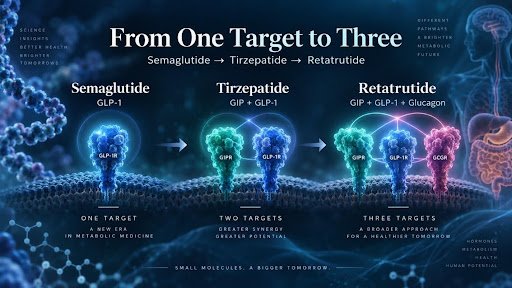
Not long ago, the modern metabolic-drug story could be explained with one receptor: GLP-1. That was complicated enough for most people. Then the science moved faster than the terminology.
Semaglutide showed just how much could happen when researchers focused on sustained GLP-1 receptor activation. Tirzepatide changed the equation by adding GIP signaling to GLP-1. Now retatrutide is testing an even broader idea: activating GIP, GLP-1 and glucagon receptors within a single molecule.
The progression is easy to summarize — one target became two, and two became three — but the biology behind it is more interesting than the slogan. Each step represents a different attempt to influence appetite, glucose regulation, energy balance and body-fat biology through coordinated hormone signaling.
The clinical data have evolved just as quickly. Semaglutide’s landmark STEP 1 trial reported an average 14.9% reduction in body weight at 68 weeks. Tirzepatide reached 20.9% at its highest dose in SURMOUNT-1. In 2026, Lilly reported an average 28.3% reduction with the highest studied retatrutide dose in TRIUMPH-1.
Those percentages come from different studies and should not be treated as a three-way head-to-head contest. What they illustrate remarkably well, however, is how quickly metabolic research has moved from selective receptor targeting toward increasingly complex multi-receptor strategies.
Semaglutide Made GLP-1 Impossible to Ignore
The first chapter is Semaglutide.
Semaglutide is a GLP-1 receptor agonist. GLP-1 is an incretin hormone involved in glucose-dependent insulin secretion, appetite regulation and gastric emptying. Rather than attempting to manipulate several metabolic pathways simultaneously, semaglutide provided researchers with a highly effective way to sustain signaling through one particularly important receptor.
That single-target strategy produced results that changed expectations.
In STEP 1, a randomized trial involving 1,961 adults with overweight or obesity without diabetes, participants receiving semaglutide 2.4 mg had an average 14.9% reduction in body weight after 68 weeks, compared with 2.4% with placebo. More than half of participants receiving semaglutide lost at least 15% of their initial weight.
At the time, results on that scale represented a major shift in obesity pharmacotherapy. More importantly from a research perspective, they validated GLP-1 signaling as something far more consequential than a narrow glucose-control pathway.
Once that happened, an obvious question followed: if one nutrient-responsive hormone pathway could have such substantial effects, what might happen if another complementary pathway were activated at the same time?
That question led to the next stage.
Tirzepatide Added a Second Metabolic Signal
Tirzepatide did not simply produce another version of GLP-1 receptor agonism. It combined GIP and GLP-1 receptor activity within the same molecule.
GIP — glucose-dependent insulinotropic polypeptide — is another incretin hormone. Like GLP-1, it participates in nutrient-responsive metabolic signaling, but the two systems are not identical. Combining them allowed researchers to investigate whether simultaneous signaling through both receptors could produce a different metabolic profile from GLP-1 agonism alone.
SURMOUNT-1 provided a striking answer. After 72 weeks, mean body-weight reductions were 15.0%, 19.5% and 20.9% with tirzepatide 5 mg, 10 mg and 15 mg respectively, compared with 3.1% with placebo. At the 15 mg dose, 57% of participants lost at least 20% of their starting body weight.
Unlike many cross-trial comparisons, semaglutide and tirzepatide have also been tested directly against one another.
In the 2025 SURMOUNT-5 trial, 751 adults with obesity but without type 2 diabetes were randomized to maximum tolerated doses of either tirzepatide or semaglutide. After 72 weeks, average weight reduction was 20.2% with tirzepatide and 13.7% with semaglutide. Waist circumference also decreased more in the tirzepatide group.
That does not establish a universal rule that adding more receptor targets will always produce greater effects. Molecules differ in potency, receptor balance, pharmacokinetics and numerous other characteristics.
What it does show is that the move from selective GLP-1 agonism to combined GIP/GLP-1 agonism was not merely theoretical. It produced a meaningfully different clinical profile in a direct randomized comparison.
By then, researchers were already asking the next question.
If dual agonism could alter the metabolic response, was there another pathway worth adding?
Retatrutide Takes the Model From Two Receptors to Three
That is where Retatrutide enters the picture.
Retatrutide, also known as LY3437943, combines activity at GIP, GLP-1 and glucagon receptors. Instead of extending the incretin model with another version of GIP or GLP-1 signaling, it adds a receptor with a distinctly different metabolic role.
Glucagon is commonly associated with hepatic glucose regulation, but its biology extends beyond that simplified description. Glucagon receptor signaling is also relevant to substrate utilization and energy expenditure. Researchers behind the Phase 2 retatrutide program proposed that adding glucagon receptor activation to GIP/GLP-1 agonism could augment effects involving energy intake, fuel utilization and energy expenditure.
That makes retatrutide more than “another GLP-1.”
It represents an attempt to coordinate three related but distinct metabolic signaling systems in one peptide.
Early clinical results made that architecture difficult to ignore.
In the Phase 2 obesity trial, participants receiving the 12 mg dose had an average 24.2% reduction in body weight after 48 weeks. Researchers also noted that the weight-loss trajectory had not clearly reached a plateau when the trial ended.
Phase 3 subsequently pushed the headline number higher.
In May 2026, Lilly reported that participants receiving 12 mg retatrutide in TRIUMPH-1 lost an average 28.3% of their body weight over 80 weeks, equivalent to about 70.3 pounds. Perhaps more strikingly, 45.3% of participants in that group achieved at least 30% weight reduction.
That result placed triple agonism firmly at the center of the next-generation metabolic research conversation.
14.9%, 20.9%, 28.3% — A Powerful Sequence, but Not a Head-to-Head Trial
Placed next to one another, the landmark numbers tell a compelling story.
| Molecule | Receptor strategy | Landmark obesity-study result |
|---|---|---|
| Semaglutide | GLP-1 | 14.9% at 68 weeks |
| Tirzepatide | GIP + GLP-1 | 20.9% at 72 weeks |
| Retatrutide | GIP + GLP-1 + glucagon | 28.3% at 80 weeks |
It is tempting to read that table as a simple ladder: one receptor produces one result, two produce more, and three produce more again.
Biology is rarely that tidy.
STEP 1, SURMOUNT-1 and TRIUMPH-1 enrolled different populations, ran for different lengths of time and used different protocols. Retatrutide has not been directly tested against both semaglutide and tirzepatide in the same large obesity trial.
The legitimate takeaway is more interesting than a simplistic ranking anyway.
Within only a few years, researchers have progressed from demonstrating the potential of selective GLP-1 signaling, to testing coordinated GIP/GLP-1 agonism, to generating late-stage data from GIP/GLP-1/glucagon triple agonism.
The architecture itself is evolving.
Why GIP Changed the GLP-1 Model
GLP-1 and GIP are both incretin hormones released in response to nutrients, but treating them as interchangeable misses the point of dual agonism.
GLP-1 receptor activation influences appetite, gastric emptying and glucose-dependent insulin secretion. GIP signaling also contributes to nutrient-dependent insulin responses and interacts with metabolic processes in adipose and other tissues.
Tirzepatide brought both signals into one molecule, effectively turning incretin therapy from a one-pathway problem into a coordinated signaling problem.
That distinction matters because metabolic regulation is inherently networked. Appetite does not operate separately from insulin signaling, adipose biology or nutrient availability. A molecule capable of influencing several of those systems simultaneously provides a different experimental framework from a selective receptor agonist.
The direct SURMOUNT-5 comparison between tirzepatide and semaglutide reinforces the idea that the specific receptor architecture can matter clinically, even though the trial itself cannot tell us which individual mechanistic component accounts for the difference.
Why Glucagon Makes Retatrutide a Different Experiment
The move from tirzepatide to retatrutide is arguably an even larger conceptual jump.
Adding GIP to GLP-1 expands incretin signaling. Adding glucagon introduces a pathway associated with a different side of energy metabolism.
This creates an unusual balancing act.
GLP-1 and GIP signaling can influence appetite and nutrient-responsive metabolic control, while glucagon receptor activity introduces effects associated with hepatic metabolism, substrate use and energy expenditure. The research question becomes whether those actions can be coordinated within one pharmacological structure in a way that changes whole-body energy balance.
Retatrutide’s Phase 2 investigators explicitly discussed this possibility, suggesting that glucagon receptor activation may augment the effects of GIP/GLP-1 agonism through changes in energy intake, substrate utilization and energy expenditure.
That hypothesis is one reason the molecule has attracted attention beyond its headline weight-loss number.
The 28.3% result is easy to communicate. The underlying question — what happens when appetite regulation, incretin signaling and glucagon-mediated metabolic pathways are manipulated together — is considerably more important scientifically.
The Evolution Is About More Than Weight Loss
The public discussion naturally centers on kilograms and percentages, but these molecules have generated research across a much wider set of metabolic outcomes.
Semaglutide studies helped establish the broader cardiometabolic relevance of sustained GLP-1 signaling. Tirzepatide research has examined glucose regulation, waist circumference and long-term diabetes risk alongside body weight. Retatrutide’s expanding Phase 3 program has now included type 2 diabetes, knee osteoarthritis, obstructive sleep apnea and other obesity-associated outcomes.
That widening scope reflects the underlying biology.
Body fat, insulin sensitivity, glucose regulation, inflammation, joint loading and cardiovascular risk do not exist in separate compartments. They interact.
The growing interest in multi-receptor agonism is therefore not simply a race toward a larger number on a scale. It is part of a broader attempt to understand whether coordinating several metabolic signals can affect interconnected systems more effectively than manipulating one pathway in isolation.
“Semaglutide vs Tirzepatide” Is Becoming a Bigger Question
Search interest still tends to frame these molecules as competitors: semaglutide vs tirzepatide, tirzepatide vs retatrutide, or simply “which one is stronger?”
Those comparisons are understandable, but they can obscure the larger scientific story.
Semaglutide is important because it demonstrated what sustained selective GLP-1 receptor agonism could achieve.
Tirzepatide is important because it provided a clinical test of dual GIP/GLP-1 signaling and later showed a difference from semaglutide in a direct obesity trial.
Retatrutide is important because it asks a new question entirely: what happens when glucagon receptor activity is added to that dual-incretin foundation?
Seen that way, these compounds are not merely three entries on a comparison chart. They represent three stages in the changing design philosophy of metabolic research.
One Target Became Two. Now Researchers Are Studying Three.
The pace of change is what makes this field unusual.
In 2021, STEP 1 helped turn semaglutide into a defining molecule for GLP-1 research, with average body-weight reduction approaching 15%.
A year later, SURMOUNT-1 reported an average 20.9% reduction at the highest tirzepatide dose, bringing dual GIP/GLP-1 agonism into the spotlight.
By 2026, TRIUMPH-1 had produced an average 28.3% reduction with retatrutide at 12 mg while providing late-stage human data on a GIP/GLP-1/glucagon triple agonist.
The percentages are impressive, but the shift in strategy may prove more consequential.
Modern metabolic research is increasingly moving away from asking what one hormone pathway can do in isolation and toward a much more complicated question: what happens when several nutrient-responsive and energy-regulating signals are deliberately coordinated?
Semaglutide made one receptor impossible to ignore.
Tirzepatide showed what could happen with two.
Retatrutide is now helping researchers find out where three can take the science next.